Video Marketing Ideas for 2026, Sorted by What You're Actually Trying to Do
Most "video marketing ideas" lists are a pile of formats with no order to them. You scroll, nod, and close the tab without filming anything. The problem is not a shortage of ideas. It is that a lead-generation video and a retention video are different jobs, and a list that mixes them forces you to do the sorting yourself.
So this is sorted for you. Four goals -- get discovered, keep people coming back, drive a sale, and build the brand -- each with concrete ideas you can shoot this week, plus the data on what actually moves the needle for that specific goal. Jump to the section that matches what you need right now.
Before you pick an idea
Nearly every benchmark below points to the same hard constraint: Retention Rabbit's 2025 YouTube benchmark reports that the average 2025 YouTube video retains about 23.7% of its viewers, and 55% are gone by the 60-second mark. Whatever you film, the first few seconds carry it.
| If your problem is... | Use this goal | Film this first |
|---|---|---|
| Nobody knows you yet | Get discovered | Repeatable series, Shorts, clips from one recording |
| People watch once and leave | Keep people coming back | Strong hooks, intent-matched structures, next-video paths |
| Attention is not turning into revenue | Drive a sale | Product-focused demos, captions, short conversion cuts |
| People buy but forget you later | Build the brand | Founder stories, surreal visuals, recurring visual devices |
If you are choosing between platform formats, pair this guide with our TikTok video ideas and YouTube video ideas guides.
Table of contents
Goal 1: Get discovered
You have no audience yet, or you have plateaued. The job here is reach: getting in front of people who do not know you.
- Idea 1 -- Build two or three repeatable series, not random one-offs. This is the single highest-leverage move, and it is not a "format." It is a structure. YouTube's own ranking logic rewards it: if a channel focuses on a clear niche with repeatable formats, the signals compound and uploads build on each other. That is why playlists, series formats, and end screens pointing to a clear next video can out-perform single-shot videos with identical retention. Give each series a consistent promise and a consistent thumbnail style.
- Idea 2 -- Use Shorts as a reach engine that feeds your real content. The spam-Shorts era is over. In 2025, the algorithm checks whether the next video keeps the viewer watching, and creators who build flow between Shorts, long videos, and live streams grow faster. Shorts are a reach engine, used to feed sessions, not replace long-form. Practically: balance matters. Creators who balance short-form with long-form maintain stronger audience retention than those who only do one.
- Idea 3 -- Hook on trending audio in the first 5 seconds. On Shorts specifically, using trending audio within the first 5 seconds can lift reach, and 50-60-second Shorts often give you enough room to build a complete micro-story. Cheap, fast, repeatable.
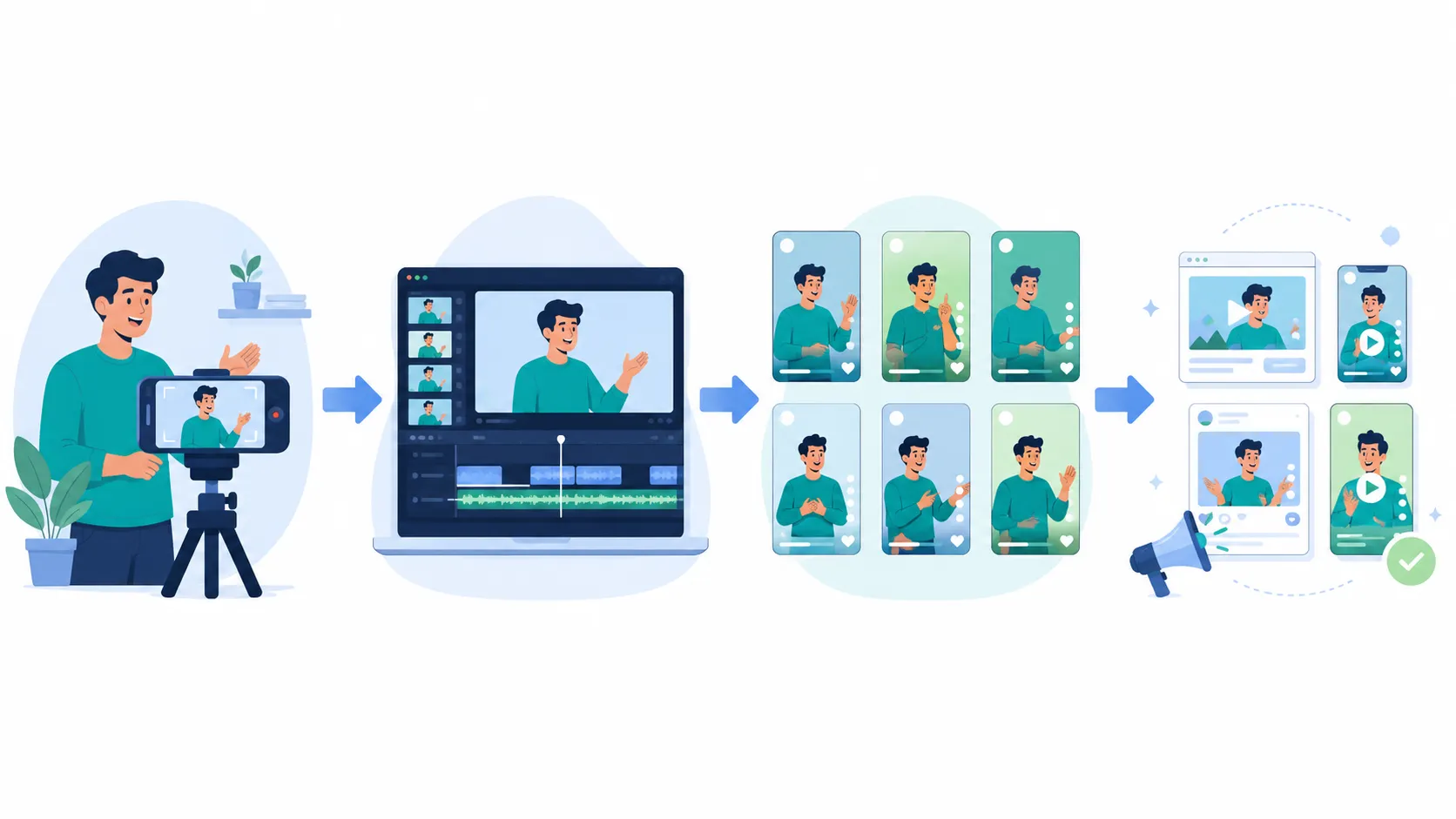
- Idea 4 -- The "one recording, many clips" pipeline. A workflow worth stealing: record 15 to 30 minutes of raw footage, cut 5 to 10 short clips, publish 3, then turn 2 into ads. One filming session becomes a week of posts.
Reality check on volume: most creators reach 1,000 subscribers in 12-16 months after posting 70-80 videos, so discovery is a compounding game, not a single viral swing.
Goal 2: Keep people coming back
Views are rented; returning viewers are owned. Channels in the top quartile for audience retention see stronger subscriber-growth momentum. The ideas here are about giving people a reason to come back.
- Idea 5 -- Front-load the hook, ruthlessly. If you are holding 70%+ of viewers in the first 30 seconds, you are in a strong position. Cut the intro. Open on the payoff or the question.
- Idea 6 -- Match your structure to your viewer's intent. A common, fixable mistake: channels targeting casual entertainment audiences sometimes use video structures built for dedicated learners. How-to content can retain well, but only if the viewer came to learn. Do not put a lecture in front of someone who came for a laugh.
- Idea 7 -- A consistent visual identity across the series. Recurring characters, voices, and visual styles build familiarity that encourages longer watch times and repeat views. Be careful with CTA timing: interrupting a high-tension moment with a "subscribe" prompt can cause sharp retention drop-offs. Weave CTAs in naturally instead.
- Idea 8 -- End every video pointing at the next one. End screens, "watch this next," and asking viewers to suggest future episodes all convert a one-time view into a session. The algorithm rewards total session time, not the single video.
A note on tools, since AI comes up here
If part of your bottleneck is producing enough visual variety to keep a series consistent week after week, this is where a video-generation + image-to-image tool like Visiva.AI fits: generating consistent visuals and scene variations across episodes so a series does not stall on production. If you want to compare production options first, use the best image-to-video AI tools guide as a companion. Two honest constraints are worth planning around:
- It handles video generation and image-to-image, not voice or lip-sync. If your idea depends on spoken delivery, that is a record-yourself or hire-a-VA job, not a generation job. This matters more than it sounds, because of the next point.
- Audiences punish "AI slop" on exactly the metric this section is about. Content perceived as heavily AI-generated or low-effort shows roughly 70% lower audience retention than human-fronted or high-effort original content in similar niches, and monotonous AI narration drives an average 35% drop-off within the first 45 seconds -- even low-quality human narration holds attention better than the best AI narration. The takeaway is not "do not use AI." It is: use it for the production grind, keep a human point of view and voice in front, and hold a quality bar. And if surreal or imaginative visuals are your angle rather than a production shortcut, see Goal 4. That is where this kind of tool earns its keep, not just saves time.
Goal 3: Drive a sale
Now the job is action, not attention. Different ideas, different rules.
- Idea 9 -- Show the product, not the lifestyle. When the goal is a sale, specificity wins: product-focused video ads can convert better than lifestyle-based ads because they remove ambiguity. Show the product, the use case, the before state, the after state, and the reason the viewer should care now.
- Idea 10 -- Caption everything for silent viewing. The cheapest conversion win on this list: many viewers mute video ads by default, but captions keep the message visible. If the message cannot be understood silently, the ad is leaking attention before the offer even arrives.
- Idea 11 -- Keep conversion videos short. One focused message, a hook within the first 2.5 seconds, subtitles on. Across video ad accounts, the useful pattern is simple: short conversion clips work best when they do one job and do it quickly. Use Meta's video ad metrics to compare hooks, hold rate, completions, and click behavior across cuts.
- Idea 12 -- Demo videos on the page where the decision happens. A product demo on a homepage, pricing page, listing page, or comparison page can answer the question that blocks action. Put the video at the point of decision, not just on the feed.
- Idea 13 -- A/B test your cut. Same footage, two hooks, two thumbnails. Let the data pick instead of arguing in the editing timeline.
| Conversion video | What to test | Why it matters |
|---|---|---|
| Product ad | First 2.5 seconds | The viewer needs the product and payoff immediately. |
| Demo page video | Objection answered first | Decision-stage viewers want clarity, not atmosphere. |
| Retargeting clip | Offer, proof, or use case | Same footage can win or lose depending on the first claim. |
Goal 4: Build the brand
The slowest-paying but most durable goal: being remembered and trusted when the buying moment eventually comes.
- Idea 14 -- Lead with narrative, creator-style, not polished brand spots. A Content Marketing Institute study cited in the source draft tracked 2,100 campaigns over 18 months and found creator-led, narrative-first branded content hit stronger unaided brand recall than traditional brand-produced content. The practical takeaway: make the viewer feel a story, not a committee-approved message.
- Idea 15 -- Put a real human / founder in frame. Trust is now a gating factor, not a nice-to-have. Behind-the-scenes clips, founder transparency, and user-generated video reviews help viewers believe the brand before they are ready to buy.
- Idea 16 -- Use surprise and escapism for emotional stickiness. Kantar BrandZ keeps pointing to meaning, difference, and salience as brand-growth forces. This is the one place where AI-generated visuals can genuinely outperform a camera rather than just substituting for one. Surreal, impossible, dreamlike imagery is exactly what text-to-image and image-to-image generation does best, and it is expensive or impossible to shoot for real.
- Idea 17 -- Pick a recurring visual device and stick with it. Whether it is a character, a signature transition, or a consistent set, recurring distinctive assets compound recall the same way a repeatable series does. That throughline is the point of the whole piece.
The difference is intent and consistency
The register that gets punished as "slop" in a straight product demo can drive shares in a brand piece. Use a recurring impossible scene, a signature dreamworld, or a visual motif your product lives inside, then repeat it until the strangeness becomes yours.
If you are stuck on "I do not even know what to film"
Every section above assumes you already have an idea and just need the right frame for it. But a lot of people -- especially solo founders and small-shop owners -- are not stuck on strategy. They are stuck one step earlier: "I am not a creative person. I do not know what to make a video about."
Here is the reframe that actually unsticks people: you are not inventing, you are documenting. If you make, sell, or do something, the work itself is the content. You do not need a concept. You need a camera pointed at what you already do.
A starter list that works for almost any product or service:
- The process, start to finish. Hands working, a thing coming together. Timelapses and close-ups are satisfying and read as real -- the opposite of AI slop.
- The questions you already get asked. Every question a customer emails you is a video. You already know the answer; just say it to a camera.
- "This took 6 hours." How long something actually takes. The honest number is the hook.
- What went wrong and how you fixed it. Mistakes-and-fixes content feels human and holds attention better than anything polished.
- Why you chose this material / color / stitch / spec. Your reasoning is the differentiation.
One idea per video. No script. A plain hook like "why this looks wrong before it looks right" beats a clever one you will never film.
Where AI fits -- and where it does not
The catch with "just film your process" is that some businesses do not have a visual process to film, or the founder does not want to be on camera at all. That is the gap a text-to-image / image-to-image tool like Visiva.AI fills: you describe the scene or feed it a reference image, and it generates the visuals -- product shots, scene variations, B-roll-style frames -- so a faceless or low-footage account still has something to show. Two honest limits to plan around, both consistent with the rest of this piece:
- It does image and video generation, not voice or lip-sync. If your idea leans on spoken delivery, that is still a record-yourself or hire-a-VA job.
- Keep a human point of view in front of it. Generated visuals carry the look; your reasoning, your answers, and your "this took 6 hours" carry the trust. Use the tool for the production grind, not as a substitute for having something to say.
Create marketing visuals with Visiva AI
- Turn product shots, reference images, or prompts into short video-ready visuals
- Generate scene variations for repeatable series, faceless videos, and brand motifs
- Keep the concept and voice human while Visiva handles the visual production grind
How to choose what to film first
Do not try to do all four at once. Match the goal to where you actually are:
- No audience? Live in Goal 1. Reach before anything else; conversion videos with nobody watching them convert nobody.
- Traffic but no loyalty? Goal 2. Returning viewers are what compound; fix retention before pouring more into reach.
- Audience but no revenue? Goal 3. You have earned attention; now make a clear, short, captioned ask.
- Selling fine but forgettable? Goal 4. Invest in the slow, durable stuff so you are remembered next quarter, not just this week.
The one rule that survives every category: pick one repeatable thing and do it consistently. The specific idea barely matters. The compounding does.
On the data: figures are cited in the source draft to their reporting source, including Meta's Creative Performance Lab, Kantar BrandZ, Content Marketing Institute, YouTube and Shorts benchmark reports, and the Retention Rabbit 2025 benchmark. Vendor-only claims and course-pitch numbers were left out rather than passed off as research.